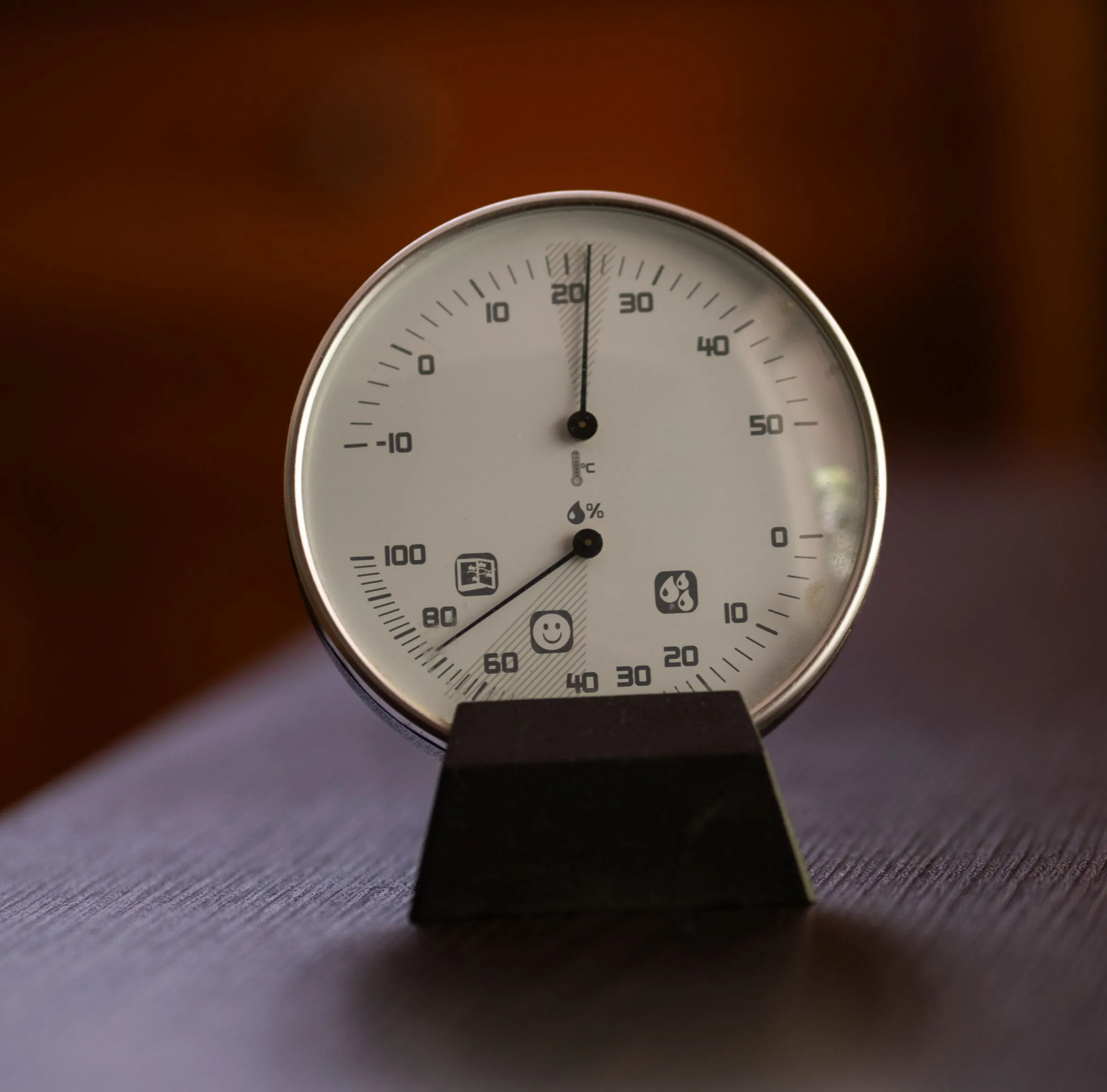
Storage / Humidity
Understanding your hygrometer
The number on the dial is an estimate. Here is how far to trust it and how to check it at home.
This page contains affiliate links. If you buy through one, Cut & Smoke may earn a commission at no extra cost to you. It does not change what is written here.
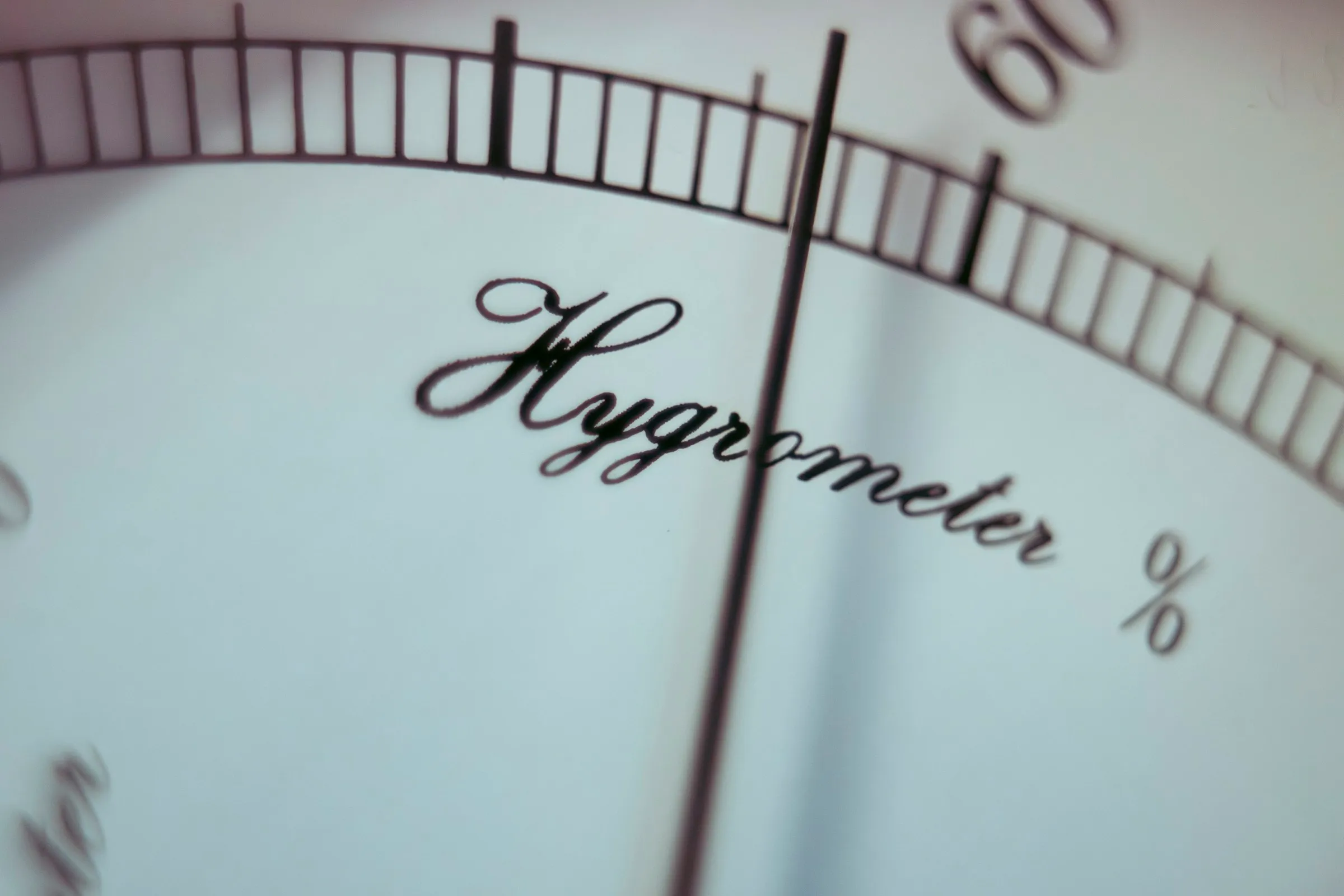
A humidor’s hygrometer shows one tidy number, and it is easy to treat that number as a fact. The UK’s National Physical Laboratory (NPL) puts it more plainly: hygrometers do not always read true, and every measurement carries some uncertainty. The useful question is how far off yours might be, and what you can do to find out.
Analog and digital
The two kinds found in humidors work in different ways:
| Type | How it works | What to look for |
|---|---|---|
| Analog dial | A material that changes size with humidity moves the needle. NPL lists hair, polymer and paper as examples. | Whether it can be adjusted, and how |
| Digital | An electronic part absorbs water vapor, and its electrical properties change. | The stated accuracy, and whether it also shows temperature |
NPL says electronic instruments are usually preferred now, though many mechanical ones remain in use for monitoring rooms. Cigar Aficionado’s 1998 storage guide is blunter. It calls analog dials frequently inaccurate and says digital models are usually reliable to within 2 percent. That guide is decades old, so treat it as a general warning, not a spec. The hygrometer on my own humidor is a dial, so that warning applies to me.
If you want a digital one, this one comes from 1st Class Humidors, which pays this site a commission. I haven’t used it. The seller states 1 percent accuracy, so read that figure with the next section in mind.
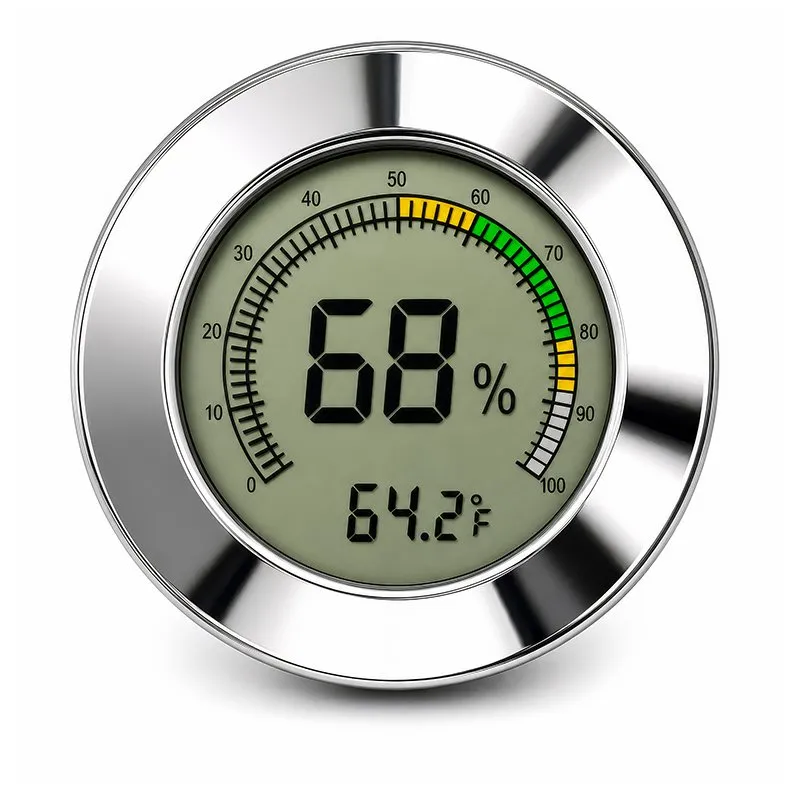
Digital hygrometer
Round digital hygrometer
Shows humidity and temperature, in Fahrenheit or Celsius. The seller states 1 percent accuracy and built-in calibration.
Check price at 1st Class Humidors (paid link, opens in a new tab)What “plus or minus 2 percent” means
NPL’s general guidance is that a relative humidity measurement might manage within 2 to 3 points in ideal conditions, and 5 to 10 points or worse in difficult ones. A small box handled at home is not a laboratory.
Spec sheets also deserve a careful read. The datasheet from Sensirion, a humidity sensor maker, for one sensor family lists a typical tolerance of plus or minus 2 points for its SHT30 part. The same document’s graph puts the maximum tolerance at about 4.5 points at 70 percent. This does not describe any particular humidor hygrometer. It does show that a headline accuracy figure can be a typical value, not a limit.
Sensors can also change over time. NPL says hygrometers can drift with use or simply with age. The same datasheet lists a low typical drift of under 0.25 points a year in normal conditions. It also says long exposure above 80 percent can temporarily push readings up, by about 3 points after 60 hours in its example. That is one sensor’s figure, but it is a reason to recheck a hygrometer after a box has run very wet.
Temperature moves the number
Relative humidity depends on temperature, so a reading can change when no water has entered or left the box. NPL’s example is air at 50 percent falling by about 3 points when it warms from 68°F to about 70°F.
This is why NPL calls temperature usually essential when recording relative humidity. It also warns that a cold spot in a room can give a reading higher than is typical for the space. A box next to a window, a lamp or a heating vent may be showing you a temperature change as much as a moisture change.
Where you put it
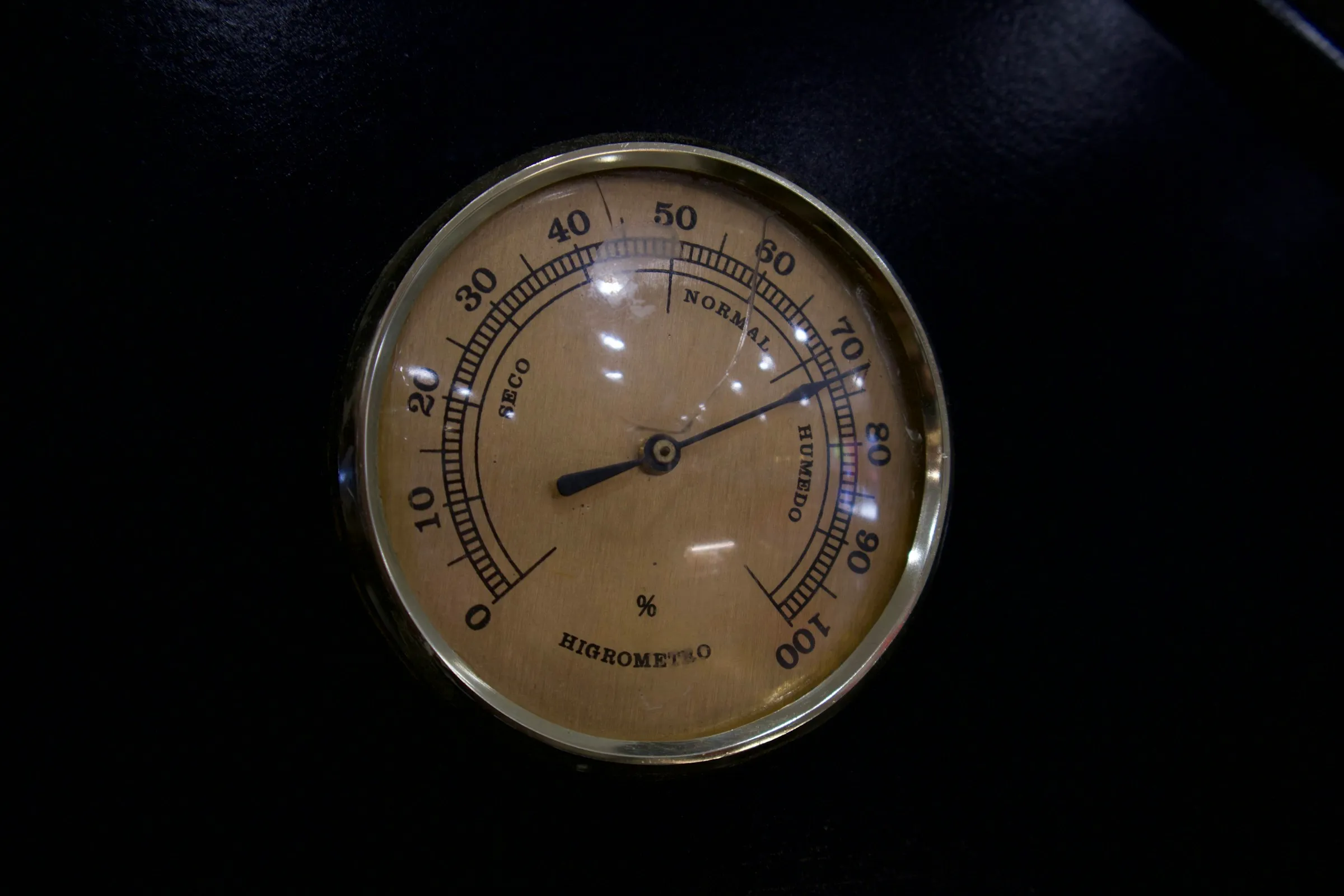
NPL’s general rule is that a measurement should represent the condition you care about. In a humidor, that means the air around the cigars. Tobacconist University, which sells tobacconist training, warns that a reading at the top of the box may not reflect the bottom, because a humidifier hanging from the top releases moisture downward. NPL also advises against measuring near pooled water, which is a good reason to keep the sensor clear of a wet humidifier.
The research for this piece did not turn up measured data on how much placement matters in a home humidor. One way to see it in your own box is to leave the hygrometer at one level for a day, then move it to another and compare.
Checking it with a salt test
The common home check uses a sealed container with damp salt. A 1954 National Bureau of Standards study measured the air above a saturated sodium chloride solution at 74.7 to 75.6 percent, from 32°F to 122°F. So the target is about 75 percent, which is also close to the range a humidor runs in.
Tobacconist University’s version mixes ½ cup of table salt and ¼ cup of water in a vessel, then seals it in an airtight bag for 24 hours at room temperature. Vaisala, which sells a salt calibrator, says the proportions do not matter as long as both liquid and undissolved salt remain.
- Mix the salt and water in a small open container. You should still see undissolved salt.
- Seal the container and the hygrometer in an airtight bag. Keep the sensor out of contact with the wet salt.
- Leave the bag somewhere the temperature is steady, away from sun and heat. Avoid handling the hygrometer, since Vaisala warns that hand heat can raise a sensor above the air temperature.
- After 24 hours, read it through the bag.
- Note the difference from 75. If it reads 72, it is reading about 3 points low, so a later reading of 67 suggests about 70.
If the hygrometer has an adjustment, you can set it to 75 and repeat the test. Otherwise, write the difference down and apply it.
What the test does not prove
NPL draws two distinctions worth keeping. Calibration is not the same as adjustment, and a check is not a calibration. A kitchen salt test is a check. It tests one point, using table salt instead of the pure materials in the 1954 study, and an offset at 75 percent may not hold exactly at 70.
Commercial kits are the alternative. Boveda’s instructions call for at least 24 hours at 65 to 75°F, then reading the difference from 75 and either recording it or adjusting the device. Boveda sells these kits, so its claims are not independent.
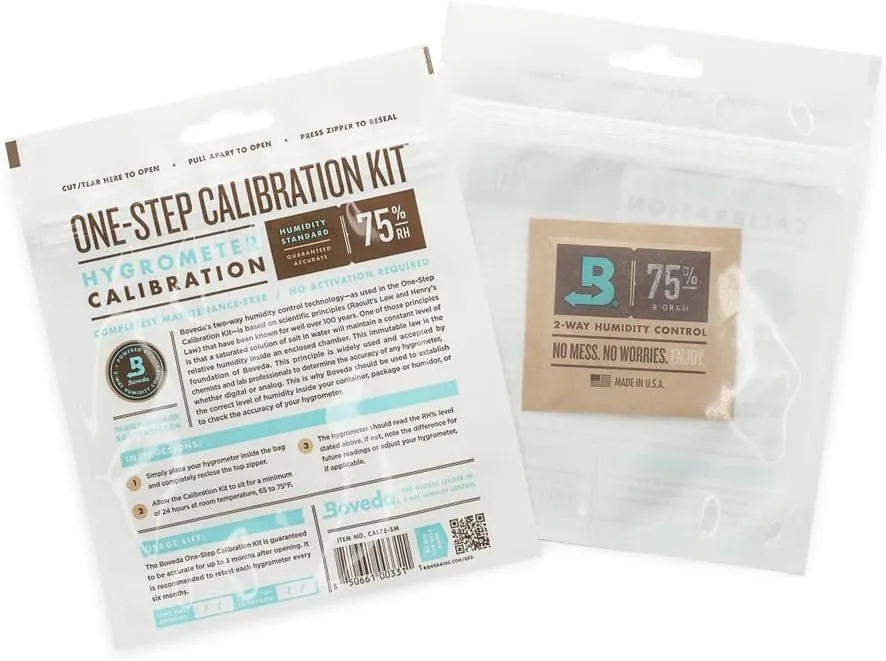
The kit in this story
Boveda 75% calibration kit
A single-use sealed kit for checking a hygrometer against 75 percent humidity.
Check price on Amazon (paid link, opens in a new tab)Tobacconist University also describes a damp towel method and says it is less accurate. NPL warns against exposing sensors to condensation unless you know they can tolerate it, so this piece leaves that method out.
How often to check
NPL says relative humidity instruments might be calibrated every 6 to 12 months, or more often if harshly treated. Boveda says every six months, and it has a kit to sell. NPL also advises an extra check after a hygrometer has been exposed to extreme conditions or mistreated, or whenever a reading looks doubtful.
If a reading surprises you, NPL’s troubleshooting list starts with the simple things: has it had time to settle, and is the temperature what you expected? Comparing against a second hygrometer also helps.
Keep notes, and keep the number in perspective
NPL recommends recording the value, the temperature, the date and time, and anything else that would help make sense of the reading later. Repeated readings give a better idea of the typical range than a single look.
The number also is not the point in itself. Cigar Aficionado’s 1998 guide says the true test of a humidor is the condition of the cigars inside, and Tobacconist University says a hygrometer does not replace your sense of touch. Both are worth remembering, although judging by feel is a skill of its own, and one a beginner has yet to build.
Where to look
The kit in this story
Boveda 75% calibration kit
A single-use sealed kit for checking a hygrometer against 75 percent humidity.
Check price on Amazon (paid link, opens in a new tab) Digital hygrometer
Round digital hygrometer
Shows humidity and temperature, in Fahrenheit or Celsius. The seller states 1 percent accuracy and built-in calibration.
Check price at 1st Class Humidors (paid link, opens in a new tab)How this was put together
Researched guide. Compiled from the published sources linked in the text. No hygrometer was measured or tested for this piece, and the one linked digital model is described from its listing. The shift per degree at 70 percent was calculated for this piece and is labelled in the text. The sources disagree about the salt test, and the article says where.
Related reading
-
Understanding your humidor’s humidity
The usual advice is 70 percent at 70°F. Here is what that number means, where it comes from and how settled it really is.
-
How to season a new humidor
Packs or a sponge, two nights or two weeks, and whether to wipe the wood at all. The guides disagree more than you’d expect, and nearly all of them sell something.